Volts podcast: Ruggedized Renewable Power for the Hardest Places with Lauren Flanagan
Excerpt
In a recent episode of Volts, Sesame Solar Co-Founder and CEO Lauren Flanagan discussed the growing need for mobile, resilient off-grid power in disaster response, defense, remote operations, and critical infrastructure settings. The conversation explored how Mobile Nanogrids combine solar, battery storage, and hydrogen backup to deliver reliable power where fuel logistics are costly, risky, or unreliable.

In a recent episode of Volts, Sesame Solar CEO Lauren Flanagan joined host David Roberts for a wide-ranging conversation about why resilient, mobile off-grid power is becoming more important in a world shaped by extreme weather, infrastructure vulnerability, remote operations, and growing energy demands at the edge. The discussion focused on the problem Sesame Solar is designed to solve: how to deliver dependable power in places where the grid is unavailable, fuel supply chains are unreliable, and downtime can carry serious operational consequences.
The episode makes clear that this is not a conversation about conventional home backup systems or ordinary rooftop solar. It is about energy for the hardest places: disaster zones, remote worksites, telecom infrastructure, military field operations, and other environments where the usual assumptions about power access do not apply. In those settings, resilience is not just about keeping the lights on. It is about keeping communications running, maintaining situational awareness, supporting essential services, and reducing dependence on fuel delivery in moments when logistics may be slow, expensive, or dangerous.
------------------------------------
Ready to explore resilient power for your operation?
From disaster response and remote communications to defense and critical infrastructure, Sesame Solar helps organizations deploy clean, mobile power where reliability matters most.
Talk to our Team
------------------------------------
Why the need for mobile resilient power is growing
One of the clearest themes in the conversation is that demand for ruggedized off-grid power is expanding because the environments that need it are becoming more common and more complex. Extreme weather events are disrupting communities and infrastructure more frequently, while defense and remote operations are relying more heavily on distributed electronics, communications systems, and autonomous technologies. That combination is creating a much larger need for deployable power systems that can operate independently for extended periods of time.
The episode frames this need as much more than a convenience issue. In many of these environments, the real challenge is not simply generating electricity. It is ensuring that power is available without being tied to a vulnerable supply chain. When roads are blocked, ports are disrupted, storms have damaged local infrastructure, or the operating environment is contested, getting liquid fuel where it needs to go can become one of the biggest obstacles to continuity.
Why fuel logistics matter as much as the energy source
A major point throughout the interview is that fuel logistics can carry enormous cost and risk. In remote or hard-to-reach locations, diesel or other liquid fuels may need to be transported over long distances by truck, ship, or even aircraft. That changes the economics dramatically and, in some settings, can also introduce serious safety and mission risks.
That is why the appeal of mobile renewable power goes beyond sustainability messaging. A system that can generate and manage power on site reduces the need to depend on a recurring external fuel supply. In practical terms, that can improve endurance, simplify logistics, and strengthen resilience in locations where the supply chain itself may be one of the weakest links.
What Mobile Nanogrids are designed to do
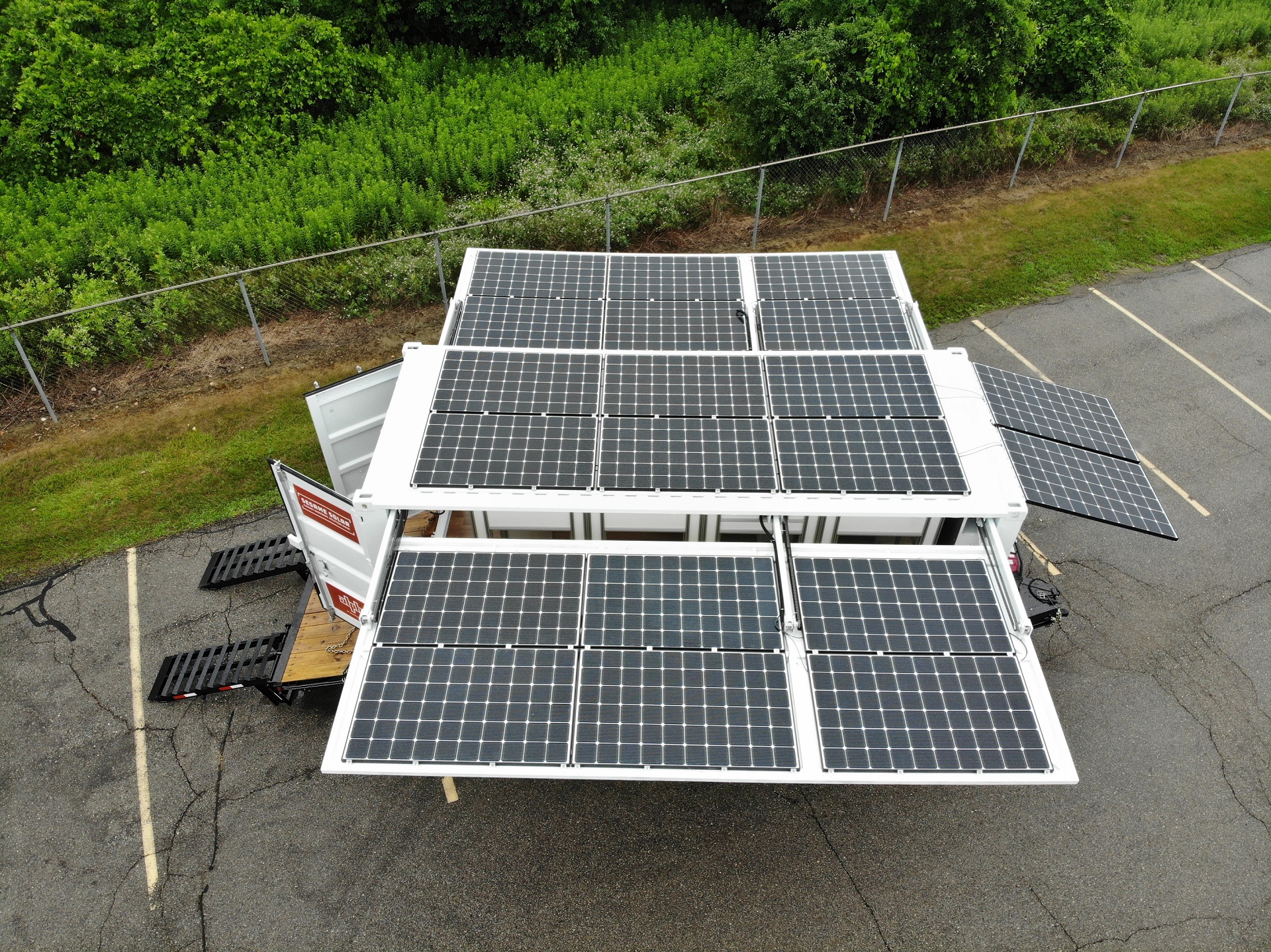
The podcast also provides a useful overview of what makes Sesame Solar’s Mobile Nanogrids different from conventional fixed solar or standard generator-based backup systems. These units are designed to be self-contained, mobile, and rapidly deployable, integrating solar generation, battery storage, power electronics, and optional hydrogen backup into one ruggedized platform. The goal is to provide a power solution that can be moved into the field, set up quickly, and operated with minimal intervention.
That design matters because many of the use cases discussed in the episode involve temporary, remote, or evolving operating environments. In those settings, flexibility is just as valuable as efficiency. A Mobile Nanogrid can support operations where permanent infrastructure is not feasible, where backup needs to move with the mission, or where resilience depends on having power available quickly after an outage or disruption.
Why hydrogen expands what these systems can do
Another important part of the conversation is the role hydrogen can play in extending operational endurance. Solar and batteries may be enough in some environments, particularly where sunlight is reliable and energy demand is manageable. But there are many cases where solar alone may not be sufficient, especially in northern latitudes, winter conditions, long-duration deployments, or applications with continuous power requirements.
In those situations, hydrogen backup can help fill the gap by supporting the battery system when solar production is low. That makes the platform more adaptable to different climates, geographies, and use cases. The point is not that every deployment needs hydrogen, but that hybridizing the system can make resilient power possible in environments where a solar-plus-battery-only approach may fall short.
The opportunity goes beyond one market
The conversation also highlights how broad the addressable opportunity is for mobile resilient power. The same core need appears across disaster response, defense, telecom, remote infrastructure, utilities, local government, and industrial operations. Dependable off-grid power is valuable anywhere operations need to continue despite disrupted infrastructure or limited access to fuel.
That is why the episode points to a dual-use opportunity. A platform that serves demanding military and field use cases can also support civilian resilience applications, from emergency management to communications continuity to infrastructure support. Over time, growth across multiple sectors can help expand adoption and create more pathways for deployment.
Why drone operations are becoming part of the discussion
One of the more forward-looking parts of the episode is the role of drones. As drone use grows across surveillance, infrastructure inspection, security, emergency response, and remote operations, the need for dependable field power also grows. Mobile nanogrids can become part of that support layer by helping provide charging, hydrogen refueling, or persistent edge power for drone operations.
This matters because drones are increasingly being used to monitor large areas, inspect vulnerable infrastructure, assess damage after disasters, and support situational awareness in difficult environments. All of those applications depend on reliable energy at the edge. The more persistent and autonomous those drone operations become, the more important mobile energy platforms will be in supporting them.
Adoption will depend on both technology and access models
The episode also points to an important business reality: wider adoption will likely depend not only on the technology itself, but also on how organizations access it. Direct ownership may make sense for some cities, counties, utilities, or defense users, but other organizations may benefit more from rental models, shared-use arrangements, or energy-as-a-service structures.
That is especially relevant in resilience markets, where some users may need access to advanced power systems without wanting to purchase and maintain them outright. As the market evolves, flexible acquisition models could play an important role in helping more communities and organizations benefit from mobile clean power.
Scaling manufacturing will shape what comes next
A final takeaway from the conversation is that future growth will depend heavily on scale. Manufacturing capacity, supply chain readiness, and production efficiency will all influence how quickly resilient mobile power can move into wider use. Lauren notes that Sesame Solar manufactures in Jackson, Michigan, and identifies faster, lower-cost production as one of the major priorities for expansion.
That focus is important because the long-term opportunity is not limited to a few highly specialized deployments. As the need for resilient off-grid power grows across public and private sectors, the ability to manufacture and deliver these systems at greater volume will become a defining factor in how quickly the market expands.
Key Takeaways from the Episode
- Reliable power in hard-to-reach places is becoming more critical.
Disaster zones, remote operations, critical infrastructure sites, and defense environments all need power systems that can operate without depending on fragile fuel delivery chains. - Fuel logistics can be as important as power generation.
In many environments, the biggest challenge is not simply producing electricity. It is getting fuel to the right place safely, affordably, and on time. - Mobile Nanogrids are built for fast deployment and self-contained operation.
A ruggedized system that combines solar, battery storage, and power controls in one mobile unit can help organizations restore or establish power more quickly in the field. - Hydrogen backup can extend power availability when solar alone is not enough.
In locations with low sunlight, long winters, or extended off-grid needs, hydrogen can help maintain continuous operation by supporting the battery system. - Resilient off-grid power has both civilian and defense applications.
The same core need shows up across emergency response, telecom backup, remote worksites, military missions, and infrastructure support: dependable power where conventional systems fall short. - Drone operations are creating a new layer of energy demand in the field.
As drones are used more for surveillance, inspections, emergency response, and security, there is growing need for mobile charging and refueling solutions at the edge. - Access models will matter alongside the technology itself.
Rentals, shared assets, and energy-as-a-service models could help more communities and organizations use resilient mobile power without needing to own the equipment outright. - U.S.-based manufacturing and scale will be important to wider adoption.
As demand grows, the ability to manufacture faster, reduce costs, and deploy at greater volume will shape how quickly these systems can expand into more markets.
Final thoughts
This conversation offers a timely look at how energy resilience is changing. It is no longer only about backup generators or stationary systems. It is increasingly about mobility, endurance, deployment speed, and the ability to operate in places where traditional infrastructure and fuel access cannot be taken for granted. For organizations thinking seriously about preparedness, continuity, and operational resilience, that shift matters.
Read the full transcript here: https://www.volts.wtf/p/ruggedized-solar-power-for-the-hard
