
Powering Recovery in Florida After Hurricane Ian
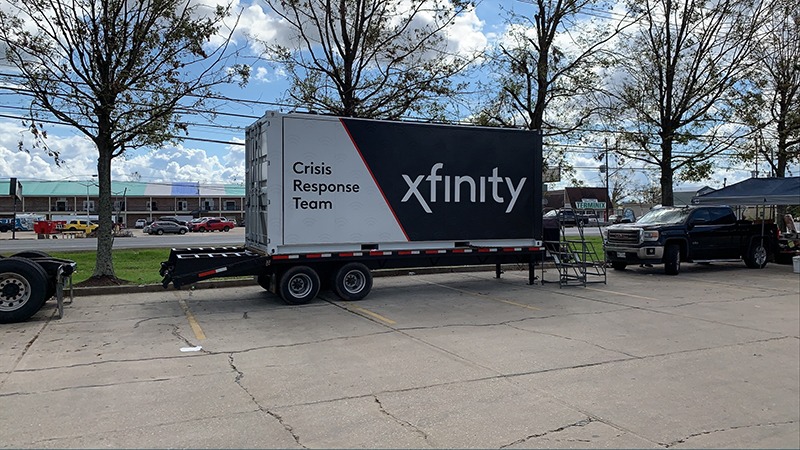
Comcast rapidly deployed Sesame Solar Nanogrids to Ft. Myers, Florida, to provide critical off-grid power following Hurricane Ian.

Overview
In the aftermath of Hurricane Ian in 2022, Comcast rapidly deployed Sesame Solar Nanogrids to Ft. Myers, Florida, to provide critical off-grid power. The Nanogrids supported emergency communications and essential services—including emergency and communication operation bases, showers, laundry, restrooms, and charging stations—serving approximately 300 emergency responders, employees and residents each day while crews worked to restore the communications network and utility grid.
Challenge
Hurricane Ian made landfall near Fort Myers as a Category 4 storm, causing catastrophic damage across Southwest Florida. A record storm surge (between 7.26-15 feet) inundated homes and businesses, while widespread flooding and infrastructure failures left much of the community without power or access to essential services. The storm ultimately caused more than $112 billion in damages, making it the costliest hurricane in Florida’s history.
With the electrical grid severely compromised and roadways impassable, diesel fuel supplies were disrupted just as the need for electricity surged. Emergency responders required dependable power to maintain communications, support emergency operations, and sustain personnel working long hours in the field.
Solution: Sesame Solar Mobile Nanogrids
Comcast deployed Sesame Solar Mobile Nanogrids to establish resilient, self-generating power exactly where it was needed. Ready for operation within minutes of arrival, the Nanogrids provided renewable power independent of the grid and fuel supply chains.
“Reliable power is fundamental to effective disaster response,” said Sesame Solar CEO and Co-founder, Lauren Flanagan. “Our Mobile Nanogrids enabled responders to focus on restoring vital services to the community without worrying about access to electricity.”
Sesame Solar’s Mobile Nanogrids were uniquely suited for the hurricane crisis:
- Rapid Deployment: Delivered and operating within minutes of arrival.
- Solar + Battery Storage: A retractable solar array and integrated battery storage enabled continuous renewable electricity—no reliance on fuel or broken supply chains.
- Essential Services in One Unit: Two Mobile Nanogrids powered two 60-foot Mobile Nanogrids housing toilets, showers and laundry facilities.
- Wi-Fi & Communications: Connections are enabled for first responders and residents.

Impact
Sesame Solar’s Mobile Nanogrids enabled uninterrupted communications and essential support services for approximately 300 people each day, allowing responders to work safely and efficiently as they restored critical infrastructure. By eliminating dependence on scarce diesel fuel, the systems ensured continuity of operations throughout the recovery effort and demonstrated the value of rapidly deployable, renewable energy in disaster zones.
The Fort Myers deployment demonstrated how rapidly deployable, renewable energy systems can strengthen community resilience and accelerate recovery when conventional power infrastructures are compromised.
Key Outcomes
- Continuous power for emergency communications and field operations.
- Access to showers, laundry, restrooms and clean water for first responders and residents.
- A scalable, replicable model for resilient disaster response.
Lessons Learned
The Fort Myers deployment underscored three essential principles of modern emergency response: speed saves lives, multifunctional systems maximize impact, and strong public-private partnerships accelerate recovery. Together, Comcast and Sesame Solar demonstrated how mobile, self-sustaining power can strengthen preparedness and help communities recover faster from future disasters.
Conclusion
The Hurricane Ian response in Fort Myers demonstrated that resilient, rapidly deployable energy systems are essential to modern disaster recovery. By providing clean, self-sustaining power and critical support services when traditional infrastructure was unavailable, Sesame Solar Mobile Nanogrids enabled responders to maintain operations, restore communications, and care for the community with dignity and efficiency.
This deployment offers a proven model for future emergency response efforts, showing how innovative partnerships and renewable mobile power can strengthen preparedness and accelerate recovery in the face of increasingly severe weather disasters.
Read more stories like this one
Santa Barbara County Strengthens Emergency Preparedness with Renewable Mobile Power
Ready to get started with Sesame Solar?
Contact us to learn about deployment options and funding opportunities.
