Why The Military Is Moving Beyond Diesel Power
This article was written by Geri Stengel for Forbes.com and published on January 22, 2026.
For decades, diesel has been treated as a necessary evil of military operations, disaster response, and emergency infrastructure. Reliable, transportable, familiar. But in an era defined by extreme weather, contested supply chains, and new forms of warfare, diesel’s hidden costs are becoming impossible to ignore.
Those costs are not just measured in dollars per gallon. They show up in delayed response times, fragile logistics, operational risk, and lives put in danger protecting fuel convoys. Increasingly, the military and its partners are seeking alternatives that reduce vulnerability rather than increase it. One of those alternatives is mobile, self-generating power.
That shift has quietly reshaped Sesame Solar's trajectory, a Michigan-based company building mobile nanogrids that self-generate power. The technology didn’t change. The values didn’t either. What changed was how the company talked about them.
Fuel Is A Liability, Not Just A Line Item
In modern military operations, fuel is both essential and exposed. Supplying it requires long, complex logistics chains that stretch across oceans, deserts, and contested terrain. Those chains are expensive to maintain and easy to disrupt.
“A bad actor can kill us in hours or minutes, and we have to be prepared for those bad actors,” Lauren Flanagan, co-founder and CEO of Sesame Solar, explained. In traditional warfare, fuel convoys are known targets. Follow the truck, and you find the base. Take out the supply line, and you cripple the operation without engaging directly.
That reality has pushed operational energy logistics to the forefront of defense planning. The question is no longer whether diesel works. The question is whether relying on it makes sense given the risk it introduces.
A Climate Solution Born From Disaster
Sesame Solar was not originally built for defense contracts. Flanagan founded the company after witnessing the devastation of Hurricane Katrina and, later, repeated failures in disaster response across the Caribbean.
“We weren’t prepared for these eventualities,” she recalled. “We don’t have mobile power units where we need them, and we’re using fossil fuels that further compound the damage after extreme weather events.”
The company’s early deployments focused on replacing diesel generators with on-site mobile nanogrids, eliminating the need for fuel deliveries. Those systems were tested under some of the harshest conditions imaginable.
From Katrina To The Caribbean
One of Sesame Solar’s earliest proving grounds came after Hurricane Maria, when a mobile nanogrid was deployed to power a remote health clinic in Dominica, supporting medical equipment, refrigeration, clean water, and communications within hours of arrival.
If the technology could work there, Flanagan believed, it could work anywhere.
The Strategic Shift: Same Mission, Different Language
The breakthrough with military customers came when Flanagan realized the barrier wasn’t technical. It was linguistic. “You don’t have to talk about renewable energy,” she observed. “You just talk about having the power that you need, when and where you need it.”
For defense buyers, climate change wasn’t the organizing principle. Operational efficiency was. Energy resilience was. Reducing logistics burden was. “We haven’t changed our mission,” Flanagan emphasized. “We just use slightly different language.”
Learning To Speak Operational Language
That shift meant leading with uptime instead of emissions. With survivability instead of sustainability. With logistics simplification instead of climate mitigation. Rather than abandoning values, Sesame Solar reframed them in terms that decision-makers were already used to hearing.
Why The Military Is Turning To Mobile Power
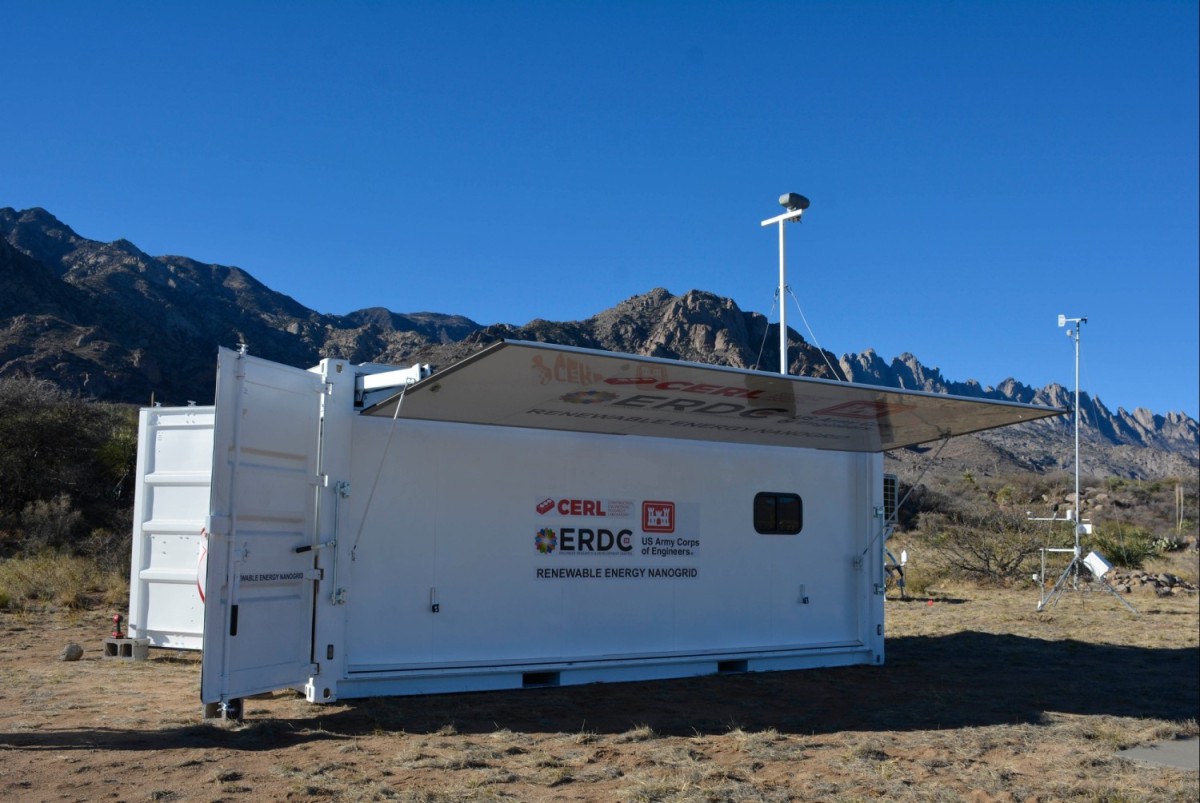
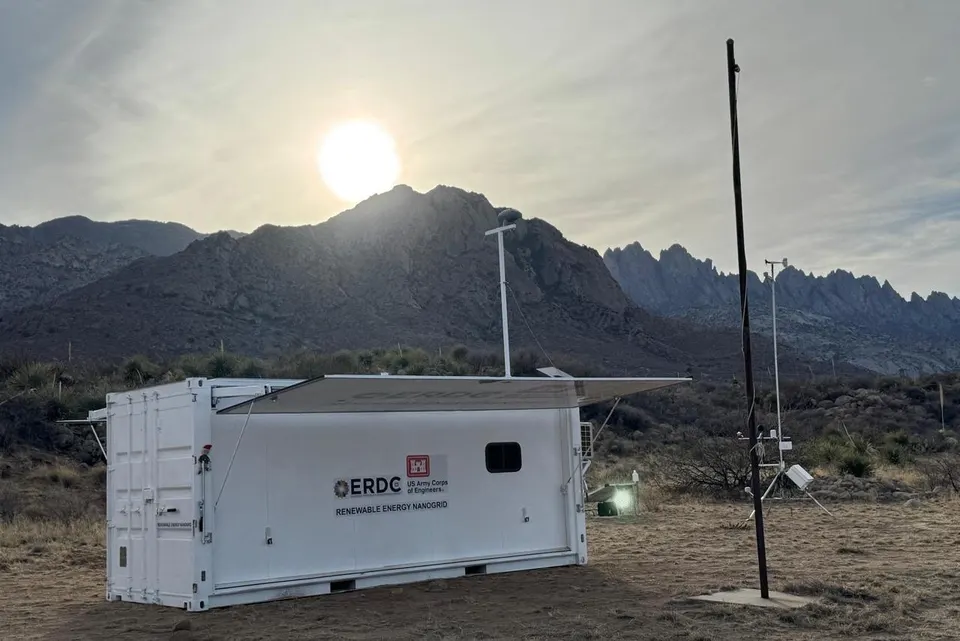
That reframing opened doors. A demonstration with the Army Corps of Engineers led to a deployment at White Sands Missile Range, where Sesame Solar installed a perimeter security and surveillance nanogrid that runs continuously without fuel. The shift is already showing up in real-world deployments: a recent Forbes article detailed how Sesame Solar’s mobile solar-to-hydrogen nanogrid can generate fuel on site to keep long-endurance surveillance drones airborne for months without a diesel supply chain, fundamentally changing how forward operations are powered.
From Demonstration To Deployment
The system has operated unmanned, 24/7, with zero power outages—an achievement the company points to as proof of fuel-free operations in austere environments.
That performance is why defense partners are paying attention. SupplyCore, Sesame Solar’s strategic distribution partner for military and federal government customers, has worked directly with the company on deployments supporting U.S. defense agencies.
“Our strategic alliance with Sesame Solar allows SupplyCore to address a critical need for customers worldwide by rapidly delivering mobile, energy-resilient solutions to military and federal agencies, ensuring mission continuity in even the most demanding environments,” Peter Provenzano, President and CEO of SupplyCore wrote in an email. “Lauren and the Sesame team have been instrumental in translating innovation into proven, operational capability.”
“Today, about half our business is coming from defense applications,” Flanagan confirmed.
Logistics As A Strategic Vulnerability
For the military, the appeal is straightforward. Mobile, self-generating power reduces reliance on fuel convoys, cuts logistics costs, and increases operational flexibility. Bases can be established faster, sustained longer, and defended with fewer vulnerabilities—particularly in the Indo-Pacific, Arctic, and other contested regions.
What This Shift Means Beyond The Battlefield
The same logic is now driving adoption outside the military. Cities, counties, utilities, and Tribal Nations face many of the same challenges: outages, extreme weather, rising costs, and fragile infrastructure. “It’s always about solving the problem first,” Flanagan pointed out.
Cities, Utilities, And Civilian Resilience
Municipalities such as the City of Ann Arbor are using mobile nanogrids not just for emergency response, but as part of their everyday resilience and community engagement strategy. The city’s Mobile Nanogrid supports emission-free events, backup power during outages, and public-facing education about energy systems.
“Sesame Solar’s Mobile Nanogrid is more than a Clean Mobile Power source—it’s a living learning lab and a community asset,” Dr. Missy Stults, Director of Sustainability and Innovations for the City of Ann Arbor wrote in an email. “It allows us to bring clean, resilient, renewable energy directly into neighborhoods for hands-on learning, emission-free events, and meaningful conversations about a sustainable energy transformation, while also giving us a flexible, resilient power source that can support essential services during outages. With our Sesame Nanogrid we are able to demonstrate how sustainability, preparedness, and community connection can work hand in hand.”
Manufacturing, Cost, And Buy American Reality
Sesame Solar manufactures its systems in the U.S., sourcing as much as possible from Michigan and the Midwest. That approach aligns with growing emphasis on domestic manufacturing, but it also exposes companies to rising labor costs, tariffs, and supply-chain uncertainty.
“If you’re chasing the lowest-cost product, tariffs and rising prices will crush you,” Flanagan argued. “We solve hard problems people are willing to pay for.” Rather than competing in commoditized energy markets, the company has positioned itself as a premium provider of mission-critical infrastructure.
The Broader Lesson
The evolution of Sesame Solar’s positioning of its mobile systems offers a broader lesson for founders operating at the intersection of infrastructure, government, and climate technology. Values do not need to be diluted to gain access. But language determines whether solutions are heard.
“Meet the customer where they are,” Flanagan advised. “Do your best not to offend, but to understand.” In a world where fuel has become a strategic liability, mobile power is no longer a niche innovation. It is fast becoming a core requirement.

Key Takeaways
- Diesel fuel is increasingly viewed as a strategic liability, not just a cost, due to exposed and fragile supply chains.
- Fuel convoys introduce operational risk, making them prime targets in contested or remote environments.
- Mobile, self-generating power systems reduce dependence on fuel deliveries, increasing flexibility and survivability.
- Sesame Solar’s adoption by defense partners accelerated through operational framing, not climate-first messaging.
- Proven, unmanned 24/7 deployments demonstrate reliability in austere environments where traditional generators struggle.
- Defense-driven energy innovation is now influencing civilian resilience, including cities, utilities, and Tribal Nations.
- Domestic manufacturing aligns with national resilience goals, even amid rising costs and supply chain pressures.
- The broader takeaway: energy resilience is no longer niche—it is becoming mission-critical infrastructure.
